PS5 Pro vs. PC in 2026: What a $700 Build Actually Gets You
Thinking about the PS5 Pro or building a budget PC in 2026? We break down what a $700 PC can realistically offer against Sony's rumored powerhouse console.
- PS5 Pro targets 4K at 60-120fps with graphical enhancements.
- A $700 PC in 2026 will likely offer 1080p high/1440p medium settings for new titles.
- PC offers superior flexibility, upgradeability, and broader game libraries.
- Console provides a streamlined, plug-and-play experience.
- AI Upscaling (DLSS/FSR vs. PSSR) will be crucial for both platforms.
PS5 Pro vs. PC in 2026: What a $700 Build Actually Gets You
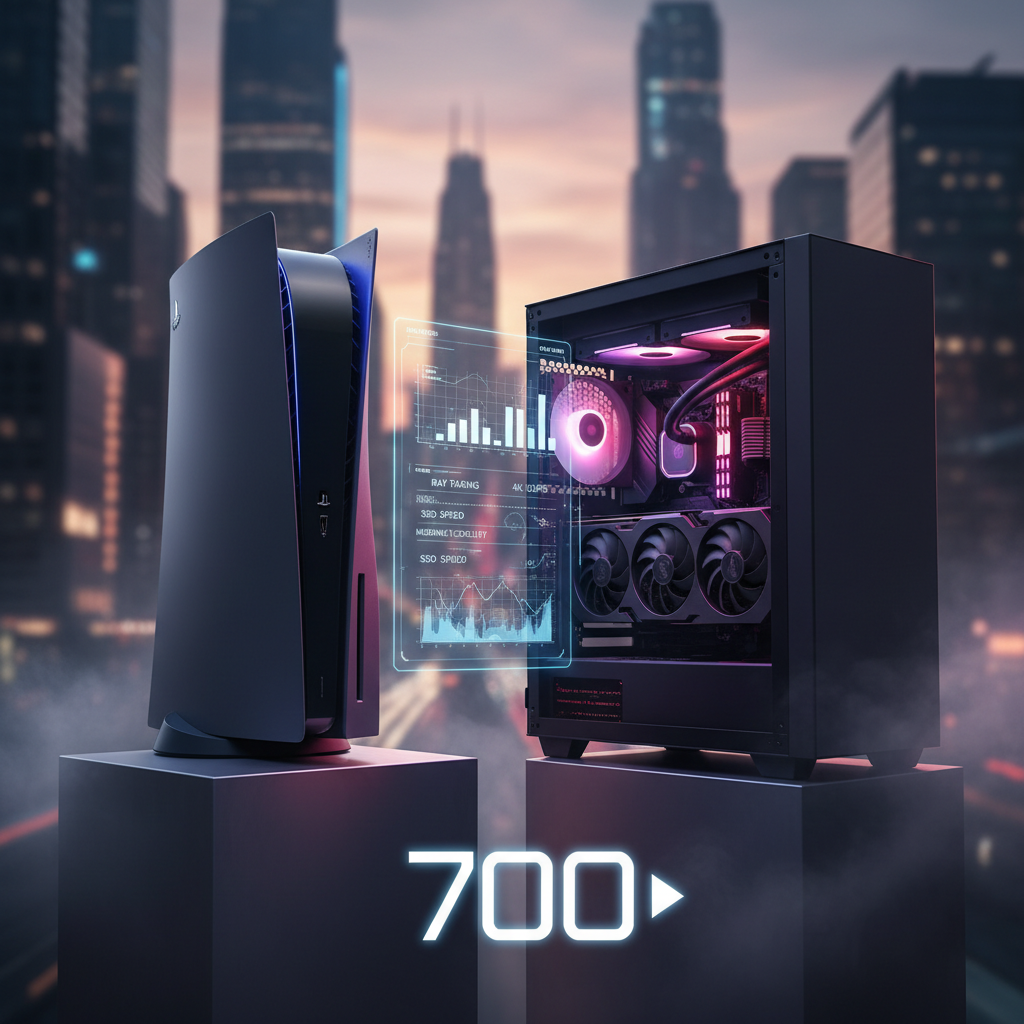
As the gaming world continually evolves, the perennial debate between console and PC gaming rages on. With rumors of a PlayStation 5 Pro (PS5 Pro) gaining steam for a potential 2026 release, many gamers are left wondering: should I invest in Sony's next-gen console iteration, or can a budget-friendly PC build offer a comparable, or even superior, experience? We're breaking down what a $700 PC build can realistically achieve by 2026 against the anticipated prowess of the PS5 Pro.
The Anticipated Power of the PS5 Pro
While PS5 Pro specs remain speculative, industry whispers and precedent suggest a significant upgrade over the base PS5. We expect enhanced GPU performance (potentially double that of the original PS5), faster CPU clock speeds, and most importantly, a dedicated focus on accelerated AI upscaling technology (likely leveraging Sony's PlayStation Spectral Super Resolution, PSSR). The goal will be to enable more consistent 4K 60-120fps gameplay, improved ray tracing, and visually richer experiences. Think games like Grand Theft Auto VI or The Witcher 4 running smoother and looking substantially better than on the standard PS5.
Key expectations for the PS5 Pro:
- Target Resolution/Framerate: 4K at 60fps+ with advanced graphical features, potentially 8K upscaled.
- AI Upscaling: Sony's PSSR for superior image reconstruction.
- Ray Tracing: Significantly improved performance over the base PS5.
- Dedicated Hardware: Fully optimized to run new generation console exclusives.
- Price Point: While unconfirmed, likely in the $500-$700 range, perhaps slightly higher at launch.
Building a $700 PC in 2026: The Reality Check
Now, let's turn our attention to what $700 can fetch you in the PC building landscape of 2026. Hardware prices fluctuate, but we can make educated guesses based on current trends and expected generational improvements.
CPU: Aim for a Solid Mid-Range
By 2026, entry-level to mid-range CPUs from AMD (Ryzen 5 series) or Intel (Core i5 series) from 2024-2025 will be significantly more affordable and powerful. A CPU like a Ryzen 5 7600 or an Intel Core i5-13600K equivalent would be ideal if purchased used or as older new stock. For $700, you'll likely be looking at a current-gen (2025/2026) entry-level Ryzen 5 or Core i3/i5, or a last-gen mid-range option. This will be more than adequate for gaming and general tasks.
- Expected: AMD Ryzen 5 X600 series (previous gen) or Intel Core i5 (previous/current entry-level).
- Cost Estimate: $150-$200
GPU: The Defining Component
The graphics card will be the most critical and expensive part of a gaming PC. For $700 total, you'll be dedicating a significant chunk to this. By 2026, we can expect the current generation's mid-range cards to have dropped in price considerably, or for new entry-level cards to offer performance akin to today's mid-range.
- Expected: Nvidia RTX 4060/4060 Ti equivalent, or AMD Radeon RX 7700 XT/7800 XT equivalent. These might move down into the $250-$350 price bracket new, or you might find even better used deals.
- Cost Estimate: $250-$350
RAM, Storage, Motherboard, PSU, Case
- RAM: 16GB DDR5 will be standard and affordable. ($50-$70)
- Storage: A 1TB NVMe SSD is essential. ($60-$80)
- Motherboard: An affordable B-series chipset to support your chosen CPU. ($100-$120)
- PSU: A reliable 600W-700W 80 Plus Bronze/Gold unit. ($60-$80)
- Case: A basic, well-ventilated case. ($40-$60)
Total Estimated PC Build Cost: $700-$800 (This is a tight budget, often requiring careful sales hunting or used components).
Performance Comparison: PS5 Pro vs. $700 PC
Let's cut to the chase:
- Resolution & Framerate: The PS5 Pro, with its optimized hardware and PSSR, will be designed to deliver a premium 4K 60fps experience in many titles, possibly even up to 120fps with variable resolution/settings. A $700 PC in 2026, while capable, will likely target 1080p high settings at 60+fps for new AAA titles, or 1440p with medium-to-low settings and reliance on FSR/DLSS for playable framerates (45-60fps). It won't comfortably push 4K on new, demanding games without significant compromises.
- Graphical Fidelity: The PS5 Pro will leverage its custom hardware and PSSR to punch above its weight, especially regarding ray tracing. While a $700 PC will have ray tracing capabilities, it will often require turning settings down significantly to maintain playable framerates, making the visual impact less pronounced than on the console.
- Loading Times: Both platforms will utilize fast NVMe SSDs, so loading times should be comparable, with the PS5 Pro perhaps having a slight edge due to deeper system optimization.
- Exclusives: This remains a key differentiator. The PS5 Pro will have access to PlayStation's acclaimed first-party exclusives, often highly optimized for the platform. A PC, while having a broader library in general, won't get these titles at launch (if ever).
Beyond Performance: Features and User Experience
PS5 Pro Advantages:
- Simplicity: Plug-and-play, no driver updates, no compatibility issues to troubleshoot.
- Exclusives: Access to Sony's first-party titles immediately.
- Optimized Games: Developers optimize games specifically for the console's fixed hardware.
- Controller: The DualSense controller's haptics and adaptive triggers offer a unique experience.
$700 PC Advantages:
- Flexibility: Modding, multiple launchers, choice of input devices, multi-purpose use (work, streaming, content creation).
- Upgradeability: You can upgrade individual components over time, extending the system's lifespan.
- Game Libraries & Sales: Access to vast libraries across Steam, Epic Games Store, GOG, and often deeper sales.
- Frame Rates (in older/less demanding titles): Can often push very high refresh rates on less intensive games.
The Verdict for 2026
For the discerning gamer in 2026, the choice boils down to priorities:
- If you want a hassle-free, optimized 4K-ish gaming experience with access to top-tier exclusives, the PS5 Pro will likely be the superior choice at a potentially comparable price point. It offers a polished, curated gaming ecosystem.
- If you value flexibility, a vast and varied game library (including older titles and indie gems), the freedom to upgrade, and are comfortable with the learning curve of PC ownership, a $700 PC build will be a rewarding, albeit perhaps visually less stunning, option. You'll get decent 1080p/1440p performance in most modern titles, and the ability to tweak and customize is unmatched.
It's important to remember that a $700 PC is a budget build. It will compete well in its price bracket but won't match a high-end PC or, for its specific optimized purpose, a console built years later with architectural improvements. The PS5 Pro promises a generational leap for console gaming, and for pure, high-fidelity gaming at its price point, it will be a very strong contender. However, the PC will always offer a broader horizon of experiences, even on a budget.
Ultimately, by 2026, a $700 PC will be a perfectly capable machine for 1080p gaming, with some ventures into 1440p, but it will not consistently outperform an optimized PS5 Pro aiming for higher resolutions and advanced features in new AAA titles.
- + PC offers unmatched flexibility and customization.
- + PC has a wider game library, often with better sales.
- + Consoles provide an optimized, hassle-free gaming experience.
- + Consoles typically offer exclusive titles not available on PC.
- + PC allows for multi-purpose use beyond gaming.
- − A $700 PC in 2026 might struggle with demanding upcoming titles at high settings.
- − PC building requires more technical knowledge and maintenance.
- − Consoles have a fixed hardware lifespan with limited upgrade options.
- − Console gaming often requires subscriptions for online multiplayer.
- − PS5 Pro's exact specs and pricing are still speculative.
Frequently asked questions
Will a $700 PC in 2026 be able to play all new games?+
Yes, a $700 PC in 2026 should be capable of playing all new games, but likely at 1080p resolution with medium to high settings, or 1440p with lower settings and upscaling technologies (FSR/DLSS) for playable framerates (45-60fps).
How will the PS5 Pro's AI upscaling (PSSR) compare to DLSS/FSR on PC?+
PSSR is Sony's proprietary solution, similar in concept to DLSS/FSR. It will be deeply integrated into the PS5 Pro hardware and software, aiming for highly optimized visual quality and performance. On PC, DLSS (Nvidia) and FSR (AMD) are widely adopted and continuously improving, offering excellent upscaling. The performance and quality will be competitive, with the PS5 Pro possibly having an edge in specific title optimization.
Is the PS5 Pro confirmed for 2026?+
The PS5 Pro is not officially confirmed by Sony, but numerous credible reports and industry analysts suggest a release around late 2025 or 2026. This article operates under the assumption of such a release with expected performance enhancements.
Can I upgrade a PS5 Pro like a PC?+
No, consoles like the PS5 Pro are closed systems. You cannot upgrade components like the CPU or GPU. You might be able to expand internal storage with a compatible NVMe SSD, but that's typically the extent of user-serviceable upgrades.
Which is better for purely competitive gaming, PS5 Pro or a $700 PC?+
For purely competitive gaming, a $700 PC might offer higher refresh rates in less demanding competitive titles (e.g., esports games) due to PC's open nature and customization. For more graphically intensive competitive games, the PS5 Pro's optimization might allow it to hit consistent high framerates at a slightly higher fidelity. Ultimately, both can be excellent, but PC offers more control over refresh rates and input lag.